

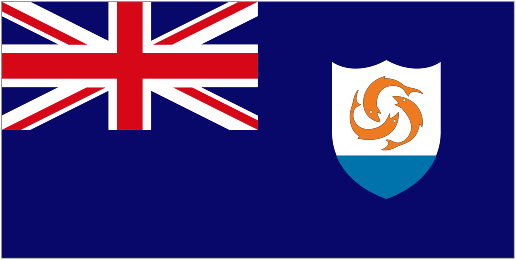
Anguilla's football story begins in 1990, when the Anguilla Football Association (AFA) was formally established on the small Caribbean island of Anguilla, a British Overseas Territory in the northeastern Caribbean. The roots of the game on the island stretch back further, however — British soldiers introduced football as early as 1969, and an informal culture of the sport grew steadily over the following decades before any governing structure existed.
The AFA's admission to both FIFA and CONCACAF in 1996 marked a turning point, granting Anguilla's national teams access to official international competition. The men's national team began participating in World Cup and Caribbean Cup qualifying campaigns from that point, though the side has historically faced considerable challenges competing against larger, more resourced nations in the CONCACAF region. A notable milestone came in 2015, when Anguilla hosted its very first full international match on home soil — a remarkable fact given that a purpose-built stadium had already been standing for over five years by then.
Women's football developed somewhat later, with the first registered female players emerging around 2003. A women's league of five teams was in place by 2006, and the women's national team began competing internationally in 2004. Both the men's and women's programmes continue to operate today.
The AFA's history has not been without controversy. A FIFA corruption scandal in 2011 led to the suspension of the association's then-president, and subsequent scrutiny revealed that despite receiving over USD 3.5 million in FIFA funds between 2000 and 2010, Anguilla had played just 17 international matches over that decade, drawing attention to governance questions that have shaped the association's identity as it works to grow the game on the island.
