

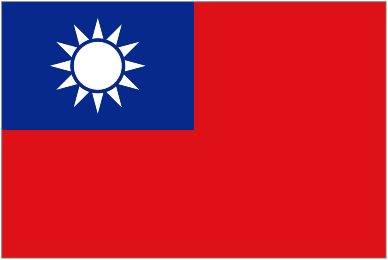
The Chinese Taipei Football Association traces its roots to 1924, when it was founded in mainland China as the China Football Association. Following the end of the Chinese Civil War, the association relocated to Taiwan in 1949 alongside the Republic of China government, and the national team began competing internationally under that name. Taiwan joined FIFA in 1954 and officially adopted the name "Chinese Taipei" in 1982, a change driven by political agreements stemming from tensions with the People's Republic of China.
The team's most celebrated era came in its early decades. Competing as the Republic of China, the side reached the semi-finals of the 1960 AFC Asian Cup, finishing third — still its best result in that competition. The team also won gold medals at the 1954 and 1958 Asian Games, though those squads drew heavily on players based in British Hong Kong. That eligibility arrangement ended in 1970, after which the team's performances declined markedly. Due to political disputes with the PRC, Chinese Taipei was expelled from the Asian Football Confederation and spent the period from 1975 to 1989 competing within the Oceania Football Confederation before being re-admitted to the AFC.
A notable resurgence came under English coach Gary White, appointed in 2017, who introduced modern tactics and a global scouting programme targeting players of Taiwanese descent. The team won seven consecutive FIFA-recognised matches and came within one point of qualifying for the 2019 AFC Asian Cup. In December 2017, Chinese Taipei claimed the CTFA International Tournament, its first official international trophy in 55 years. The team plays its home matches at the solar-powered Kaohsiung National Stadium, a 55,000-capacity landmark designed by architect Toyo Ito.
