

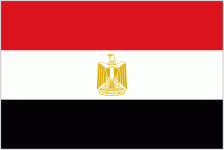

Egypt's national football team, representing one of Africa's oldest football nations, has its roots in the early twentieth century. The country's football tradition stretches back to the colonial era, and Egypt was among the first African and Arab nations to compete in international football, participating in the 1934 FIFA World Cup — the first African nation to do so.
The team's greatest source of pride is the Africa Cup of Nations, a competition Egypt has dominated more than any other country, claiming the title a record seven times. Three of those titles came consecutively between 2006 and 2010, a spell that defines the modern golden era of Egyptian football. Players from that generation, many of whom starred for storied Egyptian clubs and European leagues, remain symbols of the national team's peak.
Egypt plays its home matches primarily at Cairo International Stadium, situated in the country's capital, a city of tens of millions that provides a passionate and partisan atmosphere. The team draws its identity from a deep domestic football culture built around historic Cairo clubs, and the intensity of Egyptian club football feeds directly into national team support.
In recent decades Egypt has qualified for multiple Africa Cup of Nations finals and returned to the FIFA World Cup in 2018 after a long absence, with forward Mohamed Salah serving as the team's most recognisable modern figure. The national side continues to be a major force in African football, though recapturing the continental dominance of the late 2000s remains the benchmark against which all subsequent squads are measured.

