

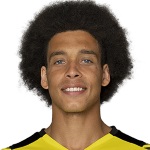
Axel Laurent Angel Witsel was born on 12 January 1989 in Liège, Belgium. The son of a Portuguese-Cape Verdean father and a Belgian mother, he came through the academy of Standard Liège before making his senior debut in 2006. By the time he left the club in 2011, he had won two Belgian First Division titles and cemented himself as one of the most promising central midfielders in European football.
After a single season at Benfica, Witsel moved to Zenit Saint Petersburg in 2012 for around €40 million, then a record for the Russian top flight. His four years in Russia were decorated by two Russian Premier League titles and allowed him to develop the composure and range that would define his later career. In 2017 he made a surprise move to the Chinese Super League with Tianjin Quanjian, but after one season he returned to European club football.
Borussia Dortmund signed him in 2018 and the move proved transformative. His metronomic passing and ability to shield the back four made him the fulcrum of a Dortmund side that challenged Bayern Munich for the Bundesliga title. He won the DFB-Pokal in 2021 and was a crucial figure in the team alongside Jude Bellingham and Marco Reus. In 2022 he joined Atlético Madrid, where he further reinvented himself as a centre-back, winning respect from Diego Simeone for his positional intelligence. He retired from professional football in 2024 after spells in Qatar.
For Belgium, Witsel was a cornerstone of the Golden Generation. He debuted in 2008 and went on to win over 130 caps, featuring at the 2014 and 2018 World Cups — where Belgium finished third — and the 2022 World Cup in Qatar. He played at four European Championships and was a constant in Roberto Martínez's midfield during Belgium's peak FIFA ranking years at the top of the world rankings.
Standing 1.87 m, Witsel was a commanding, left-footed central midfielder who combined a Rolls-Royce passing economy with the physical robustness to win the ball under pressure. His later career reinvention as a ball-playing centre-back at Atlético Madrid demonstrated an intelligence that extended well beyond athletic output.